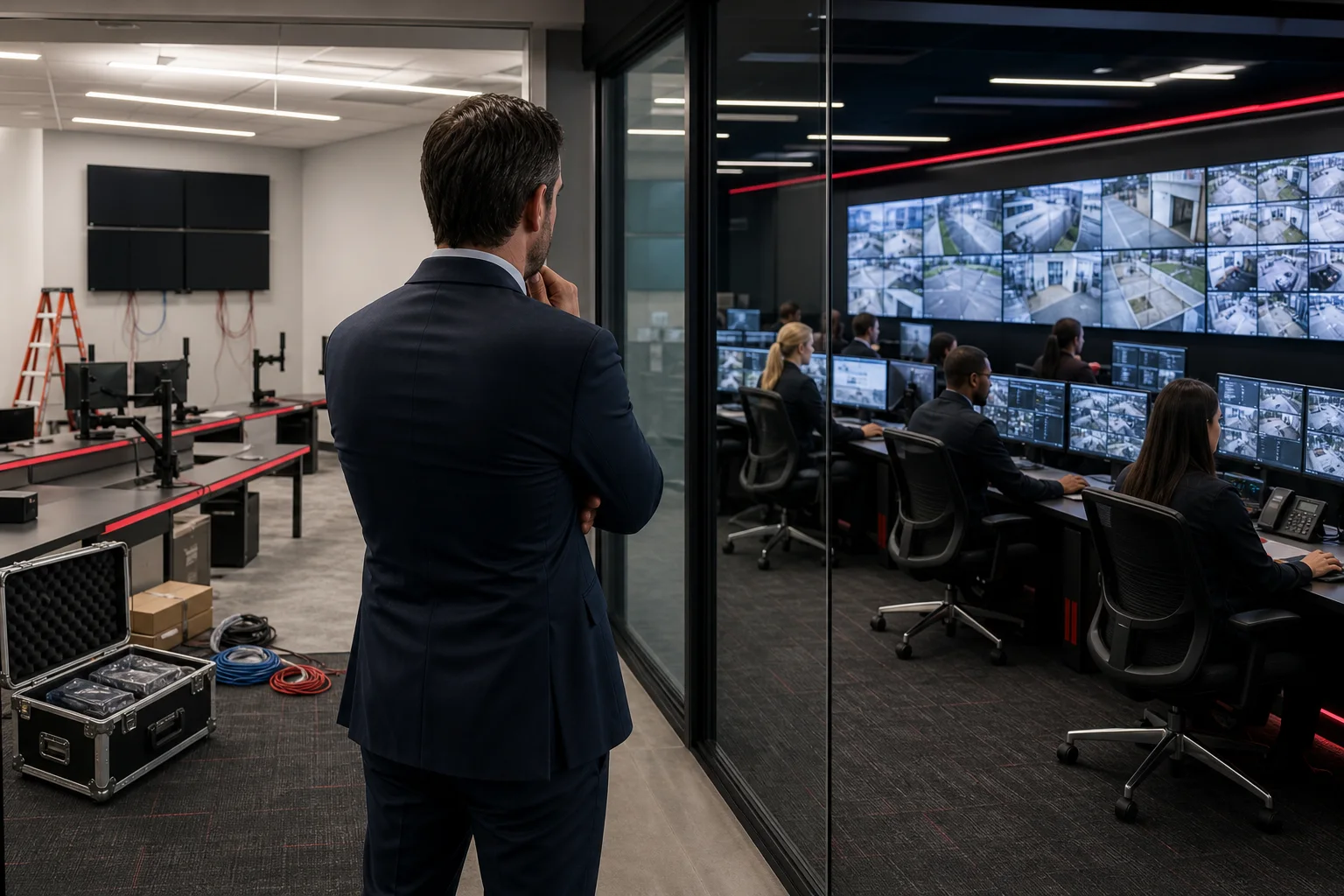
Should You Build or Outsource a Video Monitoring Center? Cost, Staffing, and Scalability Compared
Short answer: Build an in-house video monitoring center when you have stable volume, the capital to fund fixed operating costs, and the experience to manage staffing, training, technology, compliance, and quality. Outsource or use a white-label partner when you need to add capacity quickly, support fluctuating demand, or grow without adding a full operator team.
The decision is not only about software. It is an operating model decision that affects hiring, response quality, customer experience, margins, and how quickly your company can accept new accounts.
What does it take to build a monitoring center?
- Monitoring software, video access, networking, and backup connectivity.
- Operator workstations, secure access, and facility controls.
- Recruitment, training, shift scheduling, supervision, and quality assurance.
- Written procedures for verification, audio intervention, dispatch, and escalation.
- Coverage for nights, weekends, holidays, absences, and demand spikes.
- Reporting, evidence handling, customer support, and ongoing process improvement.
How does outsourcing monitoring capacity work?
An outsourced or white-label model moves some or all monitoring operations to a specialist partner. You provide the site scope, camera access, coverage schedule, customer rules, and escalation contacts. The partner provides trained operators, operational procedures, reporting, and the capacity needed to handle the agreed workload.
Build versus outsource: a practical comparison
| Factor | Build in-house | Outsource or white-label |
|---|---|---|
| Upfront investment | Higher fixed investment | Usually lower and more variable |
| Hiring responsibility | Your company owns recruiting and retention | Partner supplies the operator capacity |
| Speed to launch | Depends on hiring, training, and testing | Can be faster after scope and access are approved |
| Demand changes | Staffing may sit idle or become stretched | Capacity can flex with the portfolio |
| Operational control | Direct control over every process | Control through procedures, reporting, and governance |
| Brand experience | Your own internal operation | Can be delivered under your brand |
When does building make sense?
An in-house center may be appropriate when monitoring is a core product, volume is predictable, leadership has operational expertise, and the business can support coverage during hiring gaps and demand changes. It can also make sense when you need specialized workflows that a partner cannot provide.
When does outsourcing make sense?
- You need overflow coverage during peak hours or overnight shifts.
- You want to accept new clients before hiring more operators.
- Your camera count changes month to month.
- You want to test a new monitoring service before investing in a center.
- You need white-label delivery under your existing security brand.
- Your team wants to focus on sales, installations, and customer relationships.
Questions to ask before choosing a partner
- Which parts of monitoring are included, and which remain with our team?
- How are operators trained and quality-checked?
- What happens when an alert needs audio intervention or dispatch?
- Can the partner work with existing cameras and alarm workflows?
- How are incidents documented and reported?
- How does pricing change when sites, cameras, and coverage hours change?
- Can we start with a controlled pilot?
Frequently asked questions
Is outsourcing the same as sending customers to a generic call center?
No. A specialist video monitoring partner should provide trained operators, camera-specific procedures, visual verification, and defined escalation. Ask how the operation differs from a basic call-handling service.
Can a company use a hybrid model?
Yes. Many businesses keep strategic accounts or specialty workflows in-house and use a partner for overflow, overnight coverage, or new-account onboarding.
What is the first step?
Document your current camera count, sites, coverage hours, alert types, escalation contacts, and reporting requirements. That scope lets you compare a real operating model rather than a vague monthly estimate.
Compare your options with white-label video monitoring and request a monitoring assessment.